Projects / Featured

🕸️ Modeling Influence, Not Just Users

Turning relational data into decision-ready segments for product strategy.
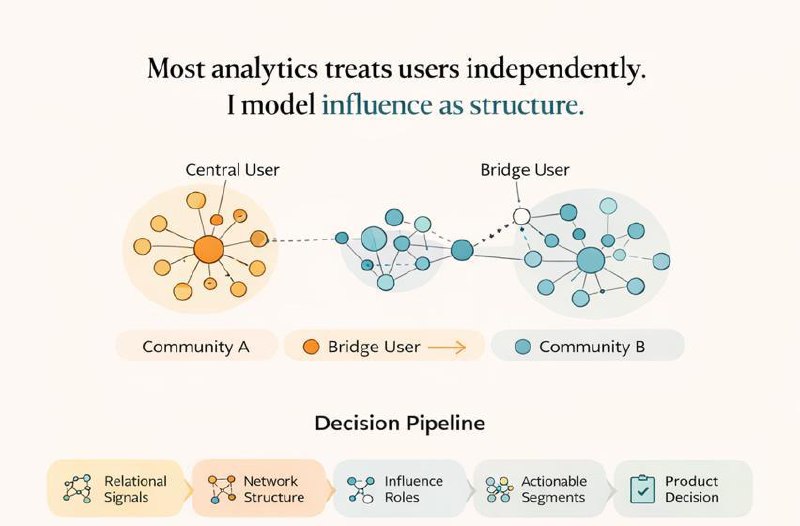
Most analytics treats users independently. I model influence as structure.
Network analysis Segmentation Social products Experiment strategy
Models
influence pathways (not averages)
Enables
where to intervene first
Outputs
actionable segments + experiment plan

Decision pipeline

Product question → relational signals → structure → roles → segments → experiments
Overview diagram: modeling influence as structure + decision pipeline

Product Challenge

Social platforms struggle to answer:
  • Where should we intervene first?
  • Which users actually shape outcomes?
  • Why do global averages fail to explain behavior?

Why Traditional Analytics Fails

Killer differentiator: influence is structural.
Typical analytics
  • ❌ treats users independently
  • ❌ ignores relational structure
  • ❌ optimizes averages instead of influence pathways
This leads to
  • misidentified “power users”
  • ineffective interventions
  • wasted experimentation cycles

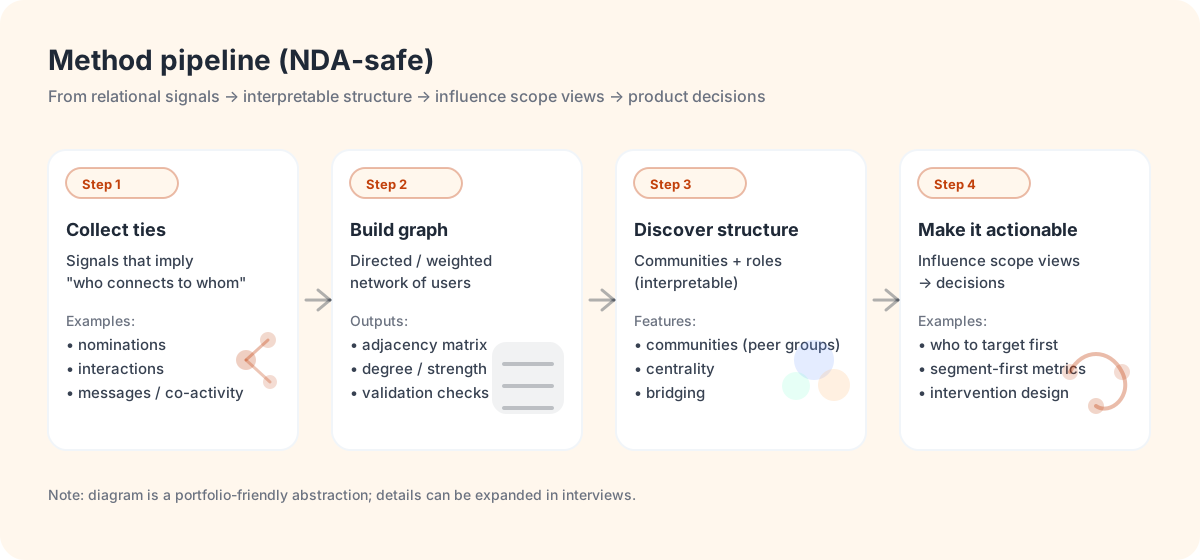
Decision Pipeline

  1. Product question (e.g., where to intervene, who to prioritize)
  2. Relational signals (interactions, nominations, communications)
  3. Network structure (communities + interpretable topology)
  4. Influence roles (central users, bridge users, local hubs)
  5. Actionable segments (segment-level measurement + targeting)
  6. Experiment design (intervention + success metrics by segment/role)
The goal isn’t “a nice graph.” It’s a framework that turns relational data into decision-ready segmentation.

Structural Insights

Insight 1 — Influence is uneven
Small subsets of users drive norm formation.
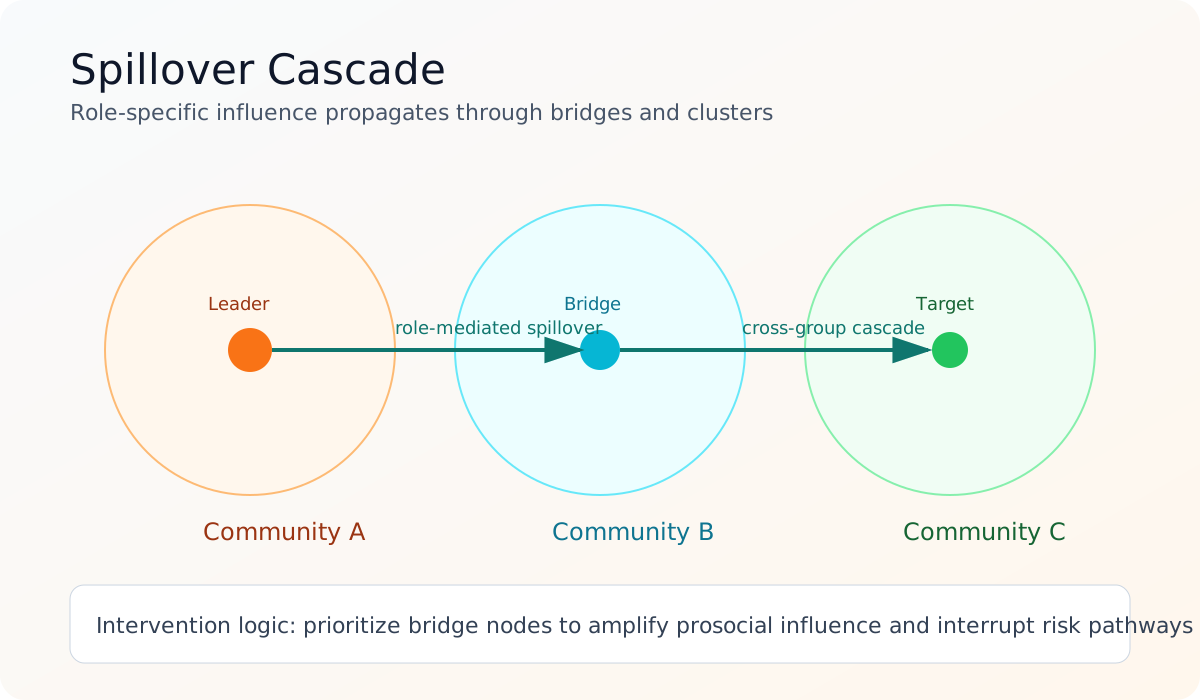
Insight 2 — Bridge users are leverage points
Changing bridges affects multiple communities simultaneously.
Insight 3 — Central ≠ positive
High centrality requires contextual validation.

What Teams Can Do With This Insight

  • Communities targeted onboarding (tailor activation + retention by segment)
  • Bridges cross-community experiments (move information across clusters)
  • Influence roles safety or growth interventions (prioritize role-based levers)
This is the hiring-manager translation: “this person helps teams decide where to intervene.”

Evidence Base

This framework builds on:
  • longitudinal network research
  • multi-level modeling of influence roles
  • validated leadership detection algorithms
Research-backed patterns (generalized)
  • Roles move. Influence positions change over time—treat segmentation as something you refresh on a cadence, not a one-time label.
  • Influence is multi-level. Some effects are local (within a cluster), others are cross-cluster—choose the level that matches the decision.
  • Bridges are high leverage. Small sets of connectors can shift outcomes across multiple clusters at once—great candidates for targeted experiments.
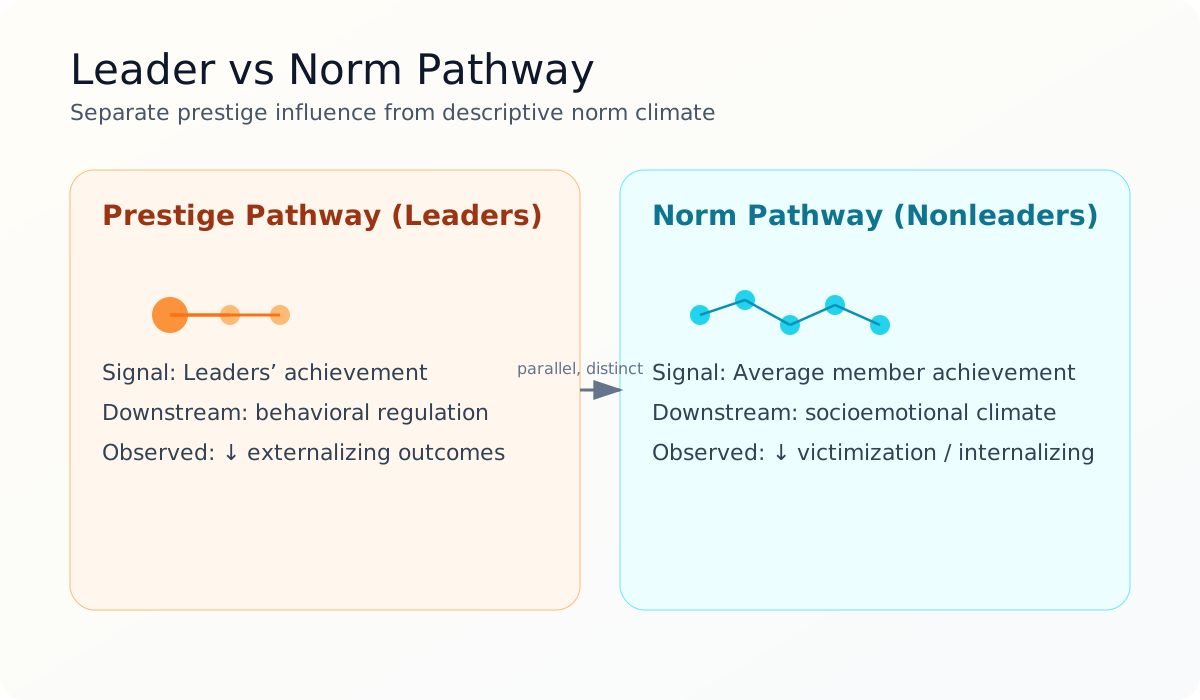
  • Separate “leader signals” from the baseline. High-visibility role holders and the broader segment norm can each matter independently—measure both.
  • Different roles → different levers + metrics. Leader signals often align with behavior-control outcomes, while baseline norms align with belonging / well-being—instrument accordingly.
Source example (open access): 10.1111/jora.70143
(Details are presented in an NDA-safe way; the emphasis here is on decision translation.)

How This Looks in Practice

NDA-safe case summary format (interview-ready).
  • network snapshot + segment labels
  • decision recommendation (what to do first, and why)
  • experiment plan (who to target, what to change, what to measure)

Network Analysis → Product Language

Hiring manager mental model translation.
Research term
Product meaning
community detection
user segmentation
centrality
influence strength
bridges
growth leverage