🕸️ Modeling Structural Influence in Complex Social Systems Through Network Science
TL;DR
Most analytics treats people as independent units. In real systems, influence emerges through relational structure.
This project builds a multi-layer network modeling framework from public bibliographic records and authorship metadata, then compares centrality measures to disentangle visibility (participation), prestige, and brokerage.
Problem
Surface metrics (counts, volume, exposure) can make popularity look like influence and miss structural roles.
Research questions
- How can structural influence be identified beyond participation volume?
- Which actors function as brokers linking otherwise disconnected clusters?
- How does network representation change the interpretation of “influence”?
Data (Open / Public)
Data: Publicly available bibliographic records and authorship metadata (publication–author relationships).
Ethics: Analysis used only publicly available records; no private user data.
Analytical Framework
Relational metadata → entity/actor extraction → edge construction → bipartite graph (author–publication) → projection (co-authorship) → metric estimation → cross-metric comparison → structural interpretation
Two complementary representations were maintained:
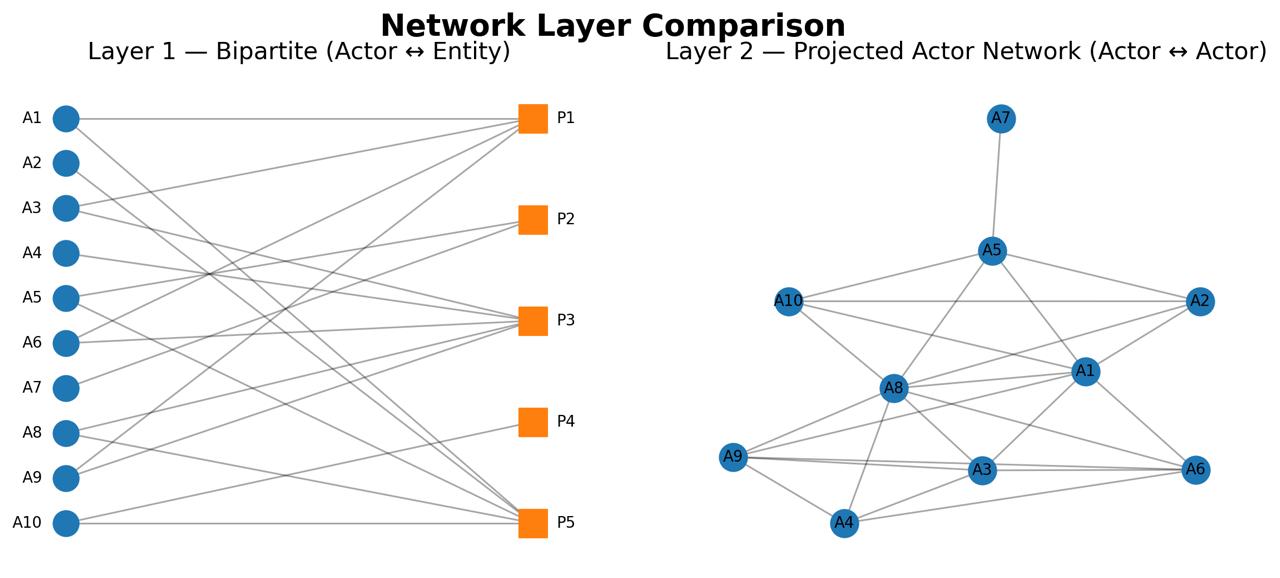
- Bipartite network (Author ↔ Publication): preserves participation context.
- Projected co-authorship network (Author ↔ Author): supports topology analysis (clusters, paths, bridges).
Structural Modeling Approach (Centrality Decomposition)
Influence was treated as multi-dimensional and evaluated via complementary measures:
- Degree: participation breadth / exposure
- Betweenness: brokerage across clusters
- Eigenvector: prestige via connectedness to influential nodes
- Closeness: global reachability / access efficiency
Visuals
1) Network layer comparison: bipartite vs projection
This illustrates why representation matters: bipartite preserves context, while projection emphasizes actor-to-actor proximity.
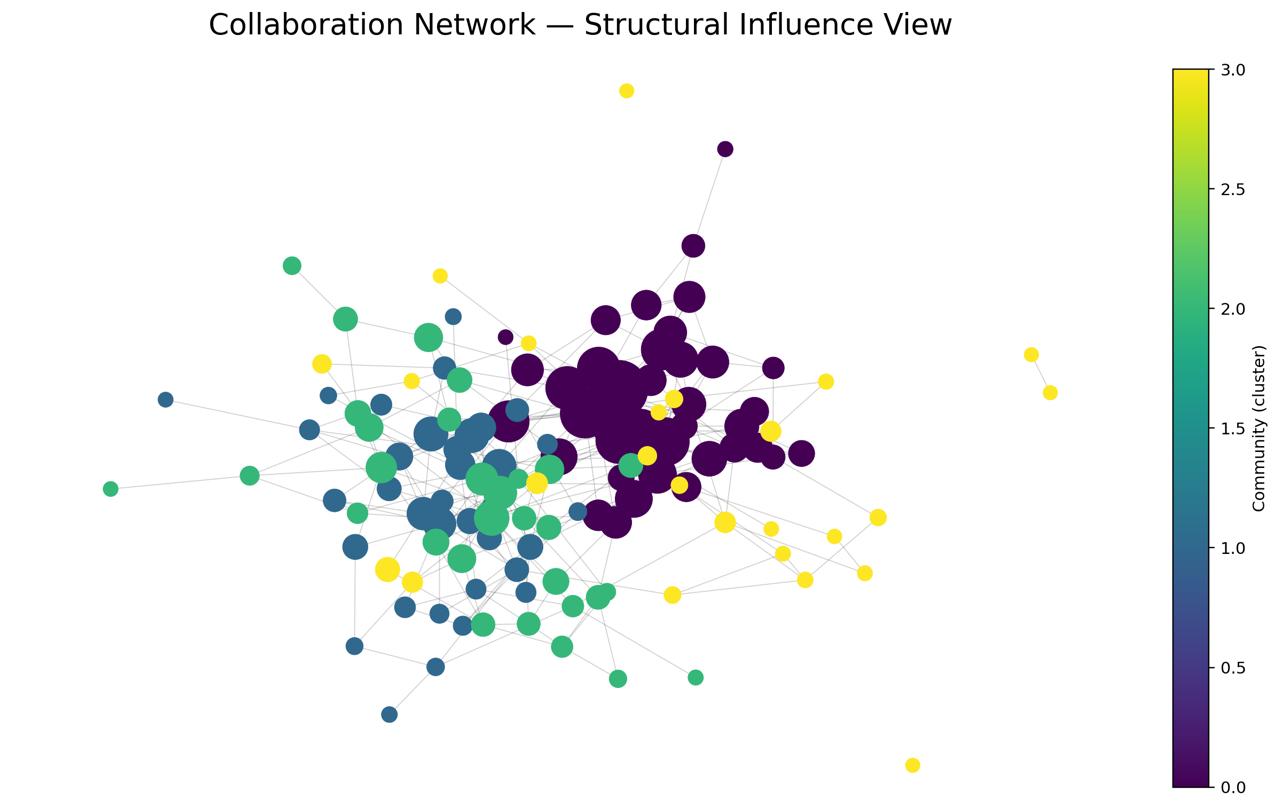
2) Collaboration network: structural influence view
A structural view highlights community structure and role differences that are not visible in individual-level counts.
Key Findings
- Prominence ≠ brokerage: High participation does not necessarily translate to structural control; betweenness surfaces brokers connecting clusters.
- Large collaborative entities can inflate apparent influence: Degree/eigenvector can be inflated by participation in high-volume entities—reflecting structural context rather than unique brokerage power.
- Representation determines interpretation: Bipartite and projected networks answer different analytical questions; keeping both reduces overinterpretation and supports defensible inference.
Deliverables
- Reproducible R/igraph pipeline (data → graphs → metrics → visuals)
- Centrality comparison framework for separating visibility, prestige, and brokerage
- Representation-aware interpretation guidelines (choosing metrics based on inference goal)
Applicability
This framework generalizes to:
- Organizational collaboration networks
- Creator ecosystems and platform communities
- Knowledge diffusion & innovation mapping
- Marketplace / partner network analysis